Performance
Electrochemical sensors have by no means to stand behind other gas measuring technologies even opposite: RoHS and its foreseeable importance as a restrictive ensuring a green, as global, future has given the company an opportunity in creatively playing with alternative possibilities to lead, hence encouraging our development department. Outstanding results are even better performing leadfree sensors than before
 Download PDF

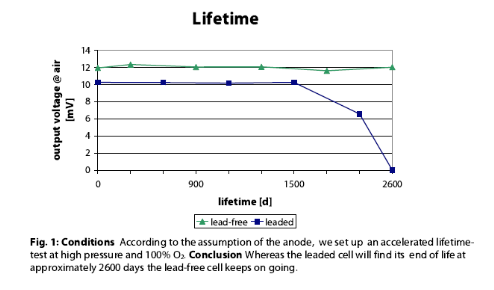
Life Time
As we tested the new leadfree cell according to lifetime, it has shown that it lasts even longer than its leaded twin (see conditions and figure right).
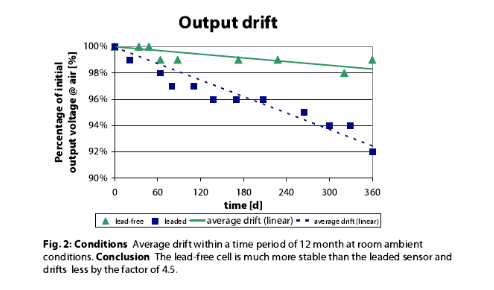

Output Drift
The new leadfree sensor has shown to drift less and even have a more stable performance than its leaded forerunner (see conditions and figure right).

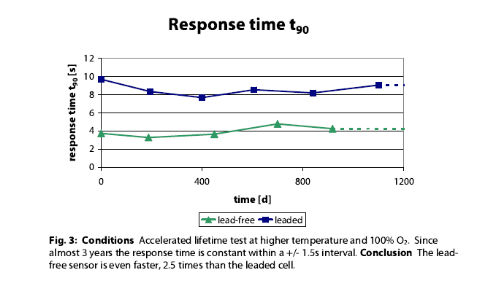
Response Time
The figure shows that new leadfree sensors from itg responds more than twice as fast than a usual cell (see conditions and figure right).

Linearity Error
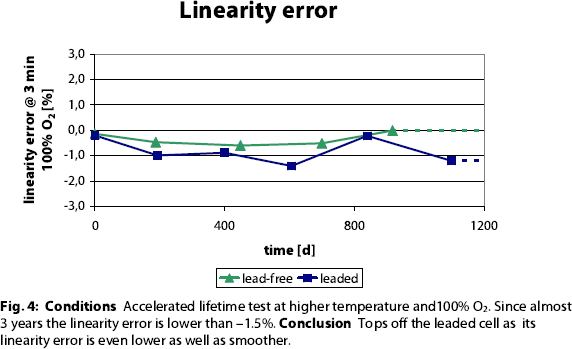
In linearity the new unleaded cell has shown unexpected and extraordinary performance: It leaves the leaded cell far behind as its linearity is observably smoother and even lower (see conditions and figure right)
Handling
Generally, it is assumed that lead-free and thus RoHS conformed sensors of IT Dr. Gambert GmbH do not differ in form(-factor), handling as well as in their chemical and electrical properties so much compared to conventional leaded sensors: in other words lead-free sensors can be considered compatible with regard to the former. In fact ITG is ensuring immediate interchangeability as it is capable of offering lead-free oxygen sensors as real drop-in replacements to the former leaded sensors.

Compatibility
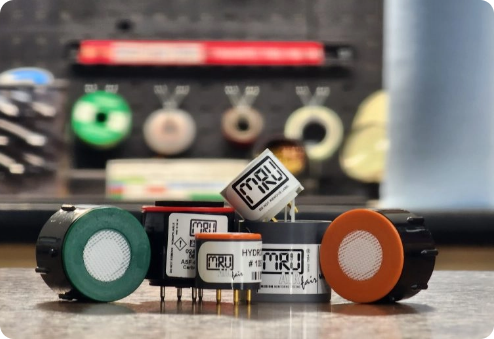
The table below depicts in what respects the lead-free sensor advantageously sets apart and where it provides equivalence to the leaded version.

Electricity
As for the electrical impedance load it should be more than 1 MOhm. We use an alkaliescent electrolyte which can be classified safe in all matters. That meets non-polluting disposal expectations.

Handling
In regard to temperature, pressure, humidity and storage conditions the usual standards apply like for the leaded sensors. Output voltage at air as well as baseline are consistent to the known output values of leaded sensors.

Interferences
Further improvements have been made on the cross-interference of the lead-free sensors. There are significantly minor cross-interferences to acid gases such as CO2, at high concentrations of acid gases, such as CO2. The sensors practically do not respond to acid gases.
| Characteristics | Lead-free | Leaded | ||||
|---|---|---|---|---|---|---|
| Compatibility |
Mechanical |

Sensor side view with typical outer housing (white cap, white thread M16x1) and approximate dimensions. |
||||
| Electrical |
Recommended |
Recommended |
||||
| Chemical |
Weak alkaline |
Strong alkaline |
||||
| Handling | Operating Temperature |
no change, typically 5–45 °C |
||||
| Operating Pressure |
no change, typically 700–1250 hPa |
|||||
| Storage Conditions |
no change, 0-100% RH, non-condensing |
|||||
| Humidity |
no change, typically 15–90% r.h., typically still at about 6 months possible |
|||||
| Basic Characteristic | Initial output voltage @ air |
no change, typically ~ 0.3 V in air |
||||
| NO2 baseline |
no change, typically < 0.2 mV vs. CO2 |
|||||
| Interferences | anaesthetic agents |
according to DIN EN ISO 80601-2-55 |
||||
| CO2 |
none @ 5% CO2 bal. N2 |
< 0.25 Vol.% @ 7 % CO2 bal. N2 |
||||
